Showing posts with label Filipino. Show all posts

Monday, December 2, 2013

On toil and soil: Pitong Sundang


There is something frightening about the way that we, as people, hold a piece of paper at high value. The thought of presenting a signature to prove ownership creates a black hole in our living. We can claim property to the land on which we were born; yet, we were raised to acknowledge ink on paper as power. The central idea posed in this chapter of our lives as a Filipino society, then, is the fact that power can absolutely change everything.

Pitong Sundang: mga Sayaw sa Lupa at Pakikibaka is an accurate depiction of the present situation of trade on Philippine soil. We have the farmer who contentedly toils his land in an effort to make ends meet in a competitive global market while looking towards better prospects for the family to which he returns. He wakes up to the sight of intruders determined to grab hold of his property and everything for which he has worked. And, they are bound to get it simply because they can. They patronize the farmer, feeding him a load of bull, until the farmer toils for them – people who barely know the labor. He soaks, chafes, and enslaves himself only to get nothing in return, to be cheated time and again. He is left with a land barren that there is barely anything left. His entire life – destroyed by snails, disfigured by locusts, and spoiled by rats – crushed by entities that are deemed untouchable because the piece of paper in their possession has created a force field around. Fight and be eaten; keep silent and get beaten anyway.

Whether we choose to look at it in that particular manner or dismiss it as another form, these illnesses have been present in our society for generations, almost like a mandatory heritage that deserved to be innate. Farmers and their family – little children – killed without any trace of reluctance; gunned down for demanding land reforms, protesting harsh labor conditions and unfair trade policies. They become a people tied at the waist, restrained by the very ones who were sworn to protect them at all costs. In our history, we have the Hacienda Luisita massacre to begin with. Who’s to say that the painfully slow bureaucracy is not here for a culmination of wealth? That the foreign countries do not seek imperialism? That the businessmen are not driven to climb a notch higher in the social hierarchy? And, if that is all so, then where are we as a people? What weapon does the meek and the poor have against the powerful?

This performance was an enchanting representation of all these issues; a wake-up call for the meek to rise as one, to reclaim the land that is truly ours. A thought that settled into me was the idea that the land, as well as the crops on which it breathes life, might as well be us, the Filipinos. It is always there to be stepped on, to dig, to read the headlines when the wind blows the hapless news, to be soaked with the blood that was shed from the hands of labor. The pests trample on it, yet it remains silent. We are caged animals: our captors anticipate our errors. Then they leap at us and rip us to tiny little shreds. And out of fear and false pretenses, we allow them because we have nothing with which to fight.

We are being called to fight: to go against the odds like the mighty heroes before us; those in the likes Andres Bonifacio, who fought his all to get this land on which we stand. Enough of the bureaucracy, the militia, foreign rulers, and negotiators. We could not let them take advantage of us anymore, or strike us, or thrust their hips unto ours. Enough submission and degradation. There is no doubt in my mind that we can always find ways to rise above errant dominion. If the answers lie on revolts, then so be it. For the price of unity and for the reclamation of what is truly ours, then so be it. It is okay to be obedient or to be good. But it is a different and a far nobler thing to do what is right. Only in this manner will we be able to contentedly plow our land again.

Thursday, October 24, 2013

Carless Sunday sa Intramuros

Linggo, hapon.

Matapos ang isang buong semestre, muli akong lumuwas sa Intramuros. Carless Sunday sa General Luna, kung saan bumulaga ang lahat ng bagay na mahiwaga. Una sa lahat, ako ay nagmistulang saling-pusa sa lakad na ito. Pero, pinush ko pa rin dahil napaghalataan ko na wala nang aaya sa akin na gumala ngayong bakasyon, matapos kong indian-in ang youth gathering ni Mico (malay ko ba kasing spiritual retreat yun!) at ang book signing ni Lourd de Veyra sa SM North (nag-abala pa naman akong basahin yung libro niya). Ito na, hindi ko na pinalagan.


Pagkatapos ng mahabang panahon, nasilayan ko muli ang aking alma mater primera. Hindi ba't parang heaven nang bumaba ako sa Plaza Lawton pagkatapos ng isa't-kalahating oras na byahe (kung saan ako natusta ng init sa loob ng FX)? Charot lang, kasi hindi naman heaven ang pag-akyat sa mapanghing underpass, pero kunyari nalang.

Nahiya naman ako at ako lang ang hindi nag-initiative mag-bestida!


Ang pambungad sa akin sa General Luna ay walang iba kundi si (drumroll please) Carlos Celdran!!! Kahit buong araw lang siyang palakad-lakad sa lansangan ng Intramuros, parang nakakahiya pa ring magpapapicture kasi ang dami niyang kausap. Pero iba talaga kapag makapal ang mukha.


Natutunan ko na hindi ka dapat pumunta sa mga ganitong okasyon kung wala kang pera. Bagaman magaganda at marami ang mga bilihin, wala ka ring mapapala kundi postcard na tig-lilimang piso at isang libreng brochure.


He he, talagang halungkat lang ang gagawin natin dito 'no?
Pakay namin talaga ang Manila Collectibles - para sa pot painting na isang linggo nang pinagnanasaan ni Bet. Nadaanan na namin at lahat-lahat, hindi pa namin napansin...

Road to paradise... charot
Hindi maipaliwanag ng damdamin ang kanyang nadarama sa tuwing ako ay napapadpad sa mga lugar sa Intramuros na gaya nito. Sadya akong nahuhumaling; parang mayroong gayuma na umaaligid hanggang sa pagtulog hanggang sa paggising sa susunod na umaga. Hindi kaya'y masyado nang mapusok ang aking kasigasigan para sa sining ng Pilipinas? Wala naman sigurong masama doon.


O eto, photo-op muna...


Mas gusto ko bang maging si Daryl Dixon...
... o si Michonne?


Sa wakas: ang pot painting corner! Kung saan ko natutunan na wala akong ka-talent-talent sa pag-kulay.


Tanghalian/Hapunan. Ewan ko ba. Sa paghahanap ng masarap na makakainan, napadpad kaming apat sa pinto ng Ristorante delle Mistre, na dating kainan ng mga fraile noong panahon ng mga Kastila. Sa labas nito, habang pinagmumunihan namin ang aming pagkakataon, agad kaming nahimok ng isang kochero na kumain na sa loob ("mura lang diyan! Ako nga nakakakain diyan eh!"). Sige, kuya, masubukan nga...

Ito na ba yung menu na pang-masa??
Ito ang nasa kisame ng aming kainan...
... ito naman ang nasa dingding!
Sabihin nalang natin na huwag kang papasok sa magagarbong kainan kapag wala kang pera. Iyong tipong walang-wala. Iyong tipong hinahalungkat mo na ang kasulok-sulukan ng iyong kalupi para lang sa barya (totoo!). Pero siyempre, kalma ka lang kasi #yolo! Charot. "Eat, drink, for tomorrow we die". At tandaan: laging magbibigay ng tip. He he, sana na-appreciate naman ni Kuya Waiter iyong smiley face na iniwan namin para sa kanya.

Gabi na nang makaalis kami. Tuloy-tuloy pa rin ang okasyon sa lansangan. Sadyang maganda pa rin ang General Luna sa gabi. Kung umuupa pa rin ako, panigurado, nakapanood pa ako ng Genghis Khan.


Salsa Sunday!


Gayunpaman, matagumpay ang eksperimentong ito. Ngayon ko lang ulit napahalagahan ang kulturang aking kinalakihan. Sana marami pang ganito! Babalik ako kapag nagkaroon ulit ng oportunidad.

At sa susunod, sisiguraduhin ko na may maiuuwi akong derby hat - terno kami ni Carlos Celdran!

more pictures:
Carless Sunday

mood - happy

Friday, July 19, 2013

Ang Oresteyas sa Tanghalang Ateneo


Masama ang bunga ng masama. Ito ang kwento ng Ang Oresteyas, isang trahedyang Griyego na umuusad sa tema ng paghihiganti. Sumisigaw ang konsepto bilang silakbo ng damdamin ng mga karakter, na bagaman katiting lamang ng kanilang pagkatao ang naipresenta ay ating nakilala batay sa mga salitang kanilang pinahayag. Kilala natin si Agamemnon sa pighating kanyang nadarama mula sa salang pag-alay ng panganay na anak na si Iphigenia; si Klytemnestra sa ganid na bumabalot sa kanyang pagkatao, na siya ring naging motibo niya sa pagpaslang sa asawa; ang mga koro o alipin sa Bahay ng Atrius sa takot at kawalan ng karapatan; si Orestes sa kanyang pangungulila sa mga magulang at mga kapatid; at si Elektra sa galit at pagnanasa na matagal niya nang inuukit sa kanyang dibdib.

Ang entablado ay tinamnan ng mga harang na nagmistulang rehas, na siyang sumisimbolo sa paglulupig: ang pagsugpo ng mga damdamin sa Bahay ng Atrius - ang pagsasalarawan ni Agamemnon ng lakas sa gitna ng pagtatangis, ang pagnanasa ni Agistos kay Klytemnestra, ang pagkimkim ni Elektra ng poot sa ina, ang hangad ni Orestes na lumaya sa sumpa ng kanyang pamilya; at ang pagsasawata ng karapatan ng mga alipin, ng mga kababaihan, at pati ng mga ordinaryong tauhan sa panahon kung saan umiikot ang storya.

Lalabas ang mga panauhin hindi lamang sa iisang entrada kundi saanman sa teatro. Moderno ang tela ng kanilang mga kasuotan, ngunit binansagan ang mga ito ng disenyo na tapat sa makalumang panahon: ang itim na korona at tsaleko ni Agamemon, na silang simbolo ng kamatayan at simula ng kalupitan; ang pulang bestida ni Klytemnestra, na nagmistulang apoy ng impyerno; ang mga maduduming basahan na suot ng mga alipin; ang bulgaridad ng blusa ni Elektra habang tinatagay niya ang bote ng alak. Hindi sila nawawala sa karakter, kahit sa ultimong paglilipat ng mga disenyo sa entablado, o pag-aabang ng parteng isasabak sa dula.

Umanod sa pula ang mga dingding ng entablado sa pagkamatay ni Agamemnon. Pula, para sa kulay ng dugo na dumagsa sa mga kamay ng asawang si Klytemnestra. Kasindaksindak ang ritmo ng musika, kasing bilis ng takbo ng puso ng isang taong balot sa pagkakasala. Nagdilim ang mga ilaw gaya ng pagdilim ng paningin ng Mahal na Reyna habang hawak ang taga na ilang ulit pang isinaksak sa katawan ng asawa. Kung pinatay niya si Agamemnon upang ipaghiganti si Iphigenia o upang mamuno sa kaharian ay hindi ko malaman. Ngunit mapapaisip ang manonood tungkol sa moralidad. Sa bandang huli, mortal lang din ang Bahay ng Atrius. Hanggang saan ang sapat para sa taong nakabalikuko sa paghihiganti? Para sa taong mataas ang mga hangarin?

Isang dalubhasang konsepto ang paggamit ng mga tagapanood bilang hukuman na hahatol kung si Orestes ba ay nagkasala o hindi. Makatarungan bang patayin ng isang anak ang kanyang ina upang ipaghiganti ang kanyang ama? Hindi nga ba't tungkuling una sa lahat ito ng anak? Papaano naman kung ang ina ang pinaslang ng anak - hindi ba ito ay kasuklamsuklam sa Diyos, pati na rin sa kapwa tao? Ang banal na obligasyon ay nakatali sa nakaririnding krimen. Siya na gusto lamang gawin kung ano ang tama ay nalagay sa posisyon kung saan dapat siyang pumili sa dalawang mali. Siya ay taksil sa kanyang ama o tagausig sa kanyang ina. Nauwi ang desisyon sa walang hatol; tabla. May kabuluhan ba ang ginawa ni Orestes? Malinis ba ang mga kamay ni Elektra sa kabila ng kanyang paghimok sa ideyang pagpaslang sa ina? Tanggap ba ng sambayanan ang ganitong konsepto ng paghihiganti? Ang paghahari ng makasalanan sa kanilang kaharian? Nasa isip na lamang ng manonood ang huling hatol.

Puti ang kulay ng kapatawaran. Sa isang eksena kung saan nagkatagpo sa kabilang buhay sina Klytemnestra at Agamemnon, maitatanong: gaano katagal darating ang kapayapaan at kapatawaran sa taong nagawan ng sala? Kaakit-akit ang ipinakitang asal ni Agamemnon - siya na nagawan ng napakalaking kasalanan ngunit mas pinili ang pagkadalisay kaysa sariling benggansa. Sa kabila ng linggatong at karahasan na pumalagi sa kanilang pagkatao, naging mapayapa ang pagtatapos ng isang paghihiganti.

Sa paglabas ko mula sa madilim at masikretong mundo ng Bahay ng Atrius, nakabuntot pa rin ang mga konsepto ng pagmamahal at pagkasuklam; pagsasalba at paghihiganti. Ramdam pa rin ang epekto ng palabas bagaman ilang oras na rin ang nakalilipas mula nang ito'y magwakas. Mga maseselang salita na hindi pangkaraniwang binibigkas; mga mahahalay na galaw na pilit inuusig sa likod ng isipan; mga kaawa-awang boses na kahit pilit busalan ay nangingibabaw kasabay ng umaalingangaw na tunog na ginamit sa dula - sila ang pinakalaman ng palabas; ang rason kung bakit naging kapanipaniwala ang pagsasabuhay ng kwento. Dadalhin ng dula ang manonood sa panahon ng Griyego, sa mundo ng isang madugong giyera, sa kailaliman ng sikreto ng lipi ng mga dugong bughaw. Nakakabusog pa rin silang isipin. Ito ang romansa ng trahedya.

Sunday, July 14, 2013

On the situation of the Philippine coastal reefs

Albeit we urge ourselves to preserve our aquatic resources in each waking hour, we still heavily sense the weight of the economy’s constant decline. Stealthily, we are losing the battle, defeated by the immensity of our own personal concerns. We recognize the foreshadowing of the unrelenting inevitable: the successive loss of our reserves is being unveiled right before our eyes. One day, all of these might just disappear.

We revert as pieces in a chess board when it comes to the protection of our aquatic resources. The whole world is just waiting for us to make a move, one independent step on the checkered arena. The few starting exchanges have been presented by foreigners: Germans, who generously exerted magnanimous effort to guide us pawns to protect the king reserves. Laid out for us the blueprint in the most convenient way imaginable – in our native tongue – to continue, if we dare.

And we ought to. The sea, with its crashing waves ushering in a new form of aquatic life, has shaped the community for the longest time. We all depend on it. Now, the community, in itself, needs to shape it. The life underneath the surfaces lies in our hands. We cannot rely on false enthusiasms created by political warfare. We look after what is given us: the simple gems that keep us afloat with our coastal identity – the ones which power we do not entirely understand until clarified further; like the humble mangrove that has the ability to avert the ugly realities of nature.

Our bay needs protection. I know people who call it their life; their livelihood. We, as consumers, ought to treat it as our sidekick: our partner in human survival. Knowing that there are people out there who care, who, without getting the proper training, know what Coastal Resource Management takes brings a warm feeling into my core. It proves true that we can, someday, stand on our own, that we will soon be the ones walking the walk and talking the talk. It is only a matter of time before we readily launch ourselves to prove it.

What we have is eventually too much for one person. For a select group of people, even. Estrangement welcomes the idea of disunity. What we need are hands of diverse backgrounds that would be willing to link together in the face of disparity. Seven thousand islands – who would take heed? Those who will notice and take time to act will be those very hands. They are the very bold who will conquer the fight towards preservation and fortification.

So, all these resources – the fish, the coasts, the mangroves – we cannot let them disappear; instead, we imagine a future bettered for, if not because of, them: with bodies of water, beginning with Iligan and Maribojok, flourishing with more than what constitutes them now. With the gangrene of anxiety extinguished from the minds of the enduring fisherman and the diligent merchant. With the livelihood that directly points to these resources stabilized as the cornerstone would a house. With the serenity encompassing the salty water accompanied by the sweet sound of native bongos. We need to see this. We cannot lose the battle; we have to keep on charging.

Thursday, February 7, 2013

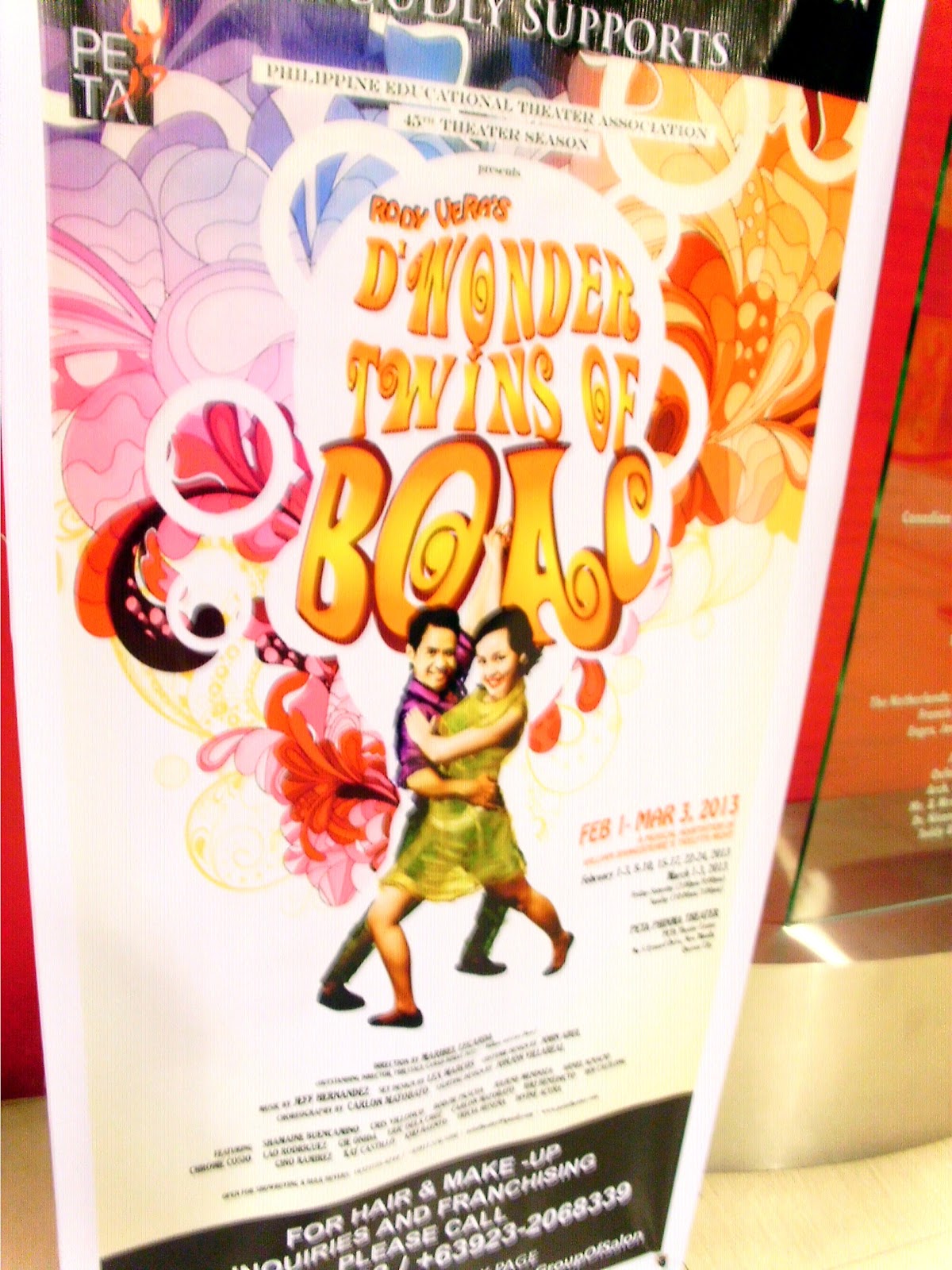
D' Wonder Twins of Boac on PETA


Following a desperate attempt on actual Filipino theater, my first PETA experience finally took place last Saturday night on the glittering streets of Eymard Drive in New Manila, in which D' Wonder Twins of Boac was showing on its first week. For some reason in which I was not supposed to be involved, I received an 80% discount on the ticket - the kind of luck that willfully drove me not to miss out on quite an opportunity.


The minute the doors were opened and I was ushered into what in theater vocabulary is a full house, I was instantly aroused by the small hall that enclosed an arena stage. I saw when the play began that the theater in the round provided the production a delightful synergy with the audience. That was when I found myself sitting next to Kenneth, the nine-year old kid of one of the caterers, and who claimed to have watched the play twice already. Yet, he persists.


Written by ingenious playwright Rody Vera, D' Wonder Twins of Boac is an adaptation of William Shakespeare's 12th Night, set in the 60's during the decline of Philippine Cinema's Golden Years, bedazzled with the unfailing loyalty of a musical that parodies the evolution of Philippine film industry.

Once the show put on its green lights, it couldn't be stopped. Not even the slightest kilo-joule of energy was lost. It deemed only the strong, right reactions, without dead air in attendance. Alas was the unraveling of passion, of secret desires and ulterior motives, the unhinging of personal interests, the offering of diverse business perspectives, unscrewing of egotism and self-rightousness, while underneath, all along, lurked the deterioration of an industry that was escorted stage left for its final exit.


One thing that I found interesting was the incorporation of the multi-media on the stage: a television screen hanging from the ceiling that subtlely dramatized the most striking acts such as the shipwreck of the twins Viola and Bastian, the slow rise of Cesar in the industry, even the bitter rivalry between Sampaguita Films and BLV Pictures. The idea fit just as well within the concept.

I think that the biggest factor that makes Boac quite easy to love is the new life that the actors breathed into their characters. We could still identify them in some of today's most powerful and influential Filipinos. It was a wholesome cast that knew their place onstage without outweighing the other. From beginning to end, not one of them fell out of persona, even off-scene. My personal favorite is the eccentric character of Malovolio, brilliantly played by Lao Rodriguez. Then there were Bastian and Antonio, and the bromance that hung over me in the morning that followed the experience.

Chrome Cosio as Bastian
Riki Benedicto as Antonio
In the end, the play turns out to be more tragic than the darkly comedic nature that, from the get-go, it had excellently expressed. What resulted from the singing and dancing, and the Elvis Presley wannabes of the late 60's was the scandalous explosion of the unflinching bare-bodied stars of the 70's Bomba era.

Director Maribel Legarda describes Boac as "not simply a period play". Call it a lesson on Filipino film or an classic that is only really meant to entertain the society that could easily identify with the business warfare of film. Beyond those, D' Wonder Twins of Boac is a recollection, a reminder, a "meaning" of the What Was Then that clicked so nicely with the Filipino film industry. It was a witness to the comings (and fadings) of stars, a classic battle royale of producers, vantage points, love and dreams detonating in disarray.